
Key Capabilities
Intelligent document processing, AI-enabled workflows, enterprise integration
Tech:
Salesforce Mulesoft and Intelligent Document Processing
Requirement Gathering, Solution Design, Development and Testing: Three phases, covering 21 weeks.
Executive overview
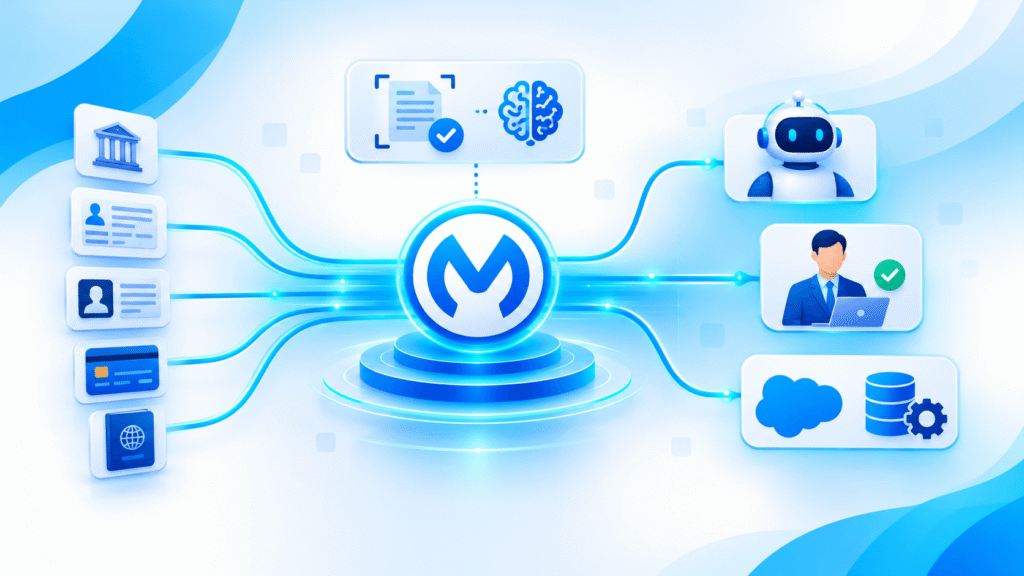
A financial-services workflow required a phased approach to document intake, extraction, decision support and integration modernisation. The proposed architecture combined MuleSoft Intelligent Document Processing, Anypoint Platform, Salesforce System APIs and MuleSoft-side Agentforce enablement.
The operating problem
Document-heavy financial workflows depend on data arriving in different formats, from different sources and with variable quality. Bank statements and payslips support income-related checks, while identity documents require different extraction and validation rules. Staff must reconcile names, addresses and amounts, assess discrepancies and manage exceptions. A second problem was the wider application landscape: existing integrations and bureau calls required a coherent orchestration and error-management layer. The proposed programme addressed these linked challenges without assuming that intelligent extraction should replace accountable human decisions.
Phased roadmap
The plan comprised three phases totalling 300 person-days, with an indicative 21 weeks of elapsed working time if phases proceeded consecutively and prerequisites were met.
Architecture and shared foundation
The first phase established Anypoint Platform configuration, CI/CD, a shared error and notification framework and a Salesforce System API. This foundation was deliberately reusable across subsequent phases. A project manager, solutions architect, MuleSoft developer, and IDP/Agentforce specialist were proposed for the initial work. Foundation work accounted for 21 person-days. The architecture separated intake and orchestration from extraction logic and downstream Salesforce updates, helping define where transformations, rules and exception handling would reside.
Document intake and extraction
Phase 1 allocated 47 person-days to intake flows, bank statements, payslips, decision logic, stage updates and associated prompts. The intention was to extract validation fields rather than indiscriminately retain all document content. For Phase 2, 30 person-days were allocated to extending the same foundation for further document categories, including passport, driving license and bank cards. This reuse was central to the phased model: shared intake and decision patterns would be adapted to document-specific layouts and field requirements rather than reconstructed for each category.
Confidence and human review
The assumptions explicitly rejected a simplistic automatic fraud verdict. Potentially doctored documents were to be assessed using confidence scores and routed to human review. Fuzzy matching for names and addresses, along with income variance thresholds. These choices matter in regulated or sensitive financial operations because an extracted value is not necessarily a verified fact. Confidence, source quality and exception handling must be visible to staff. The documents do not specify a final threshold or a measured false-positive rate, so neither should be invented.
Data minimisation and security
The scope stated that full card data, passport numbers and city of birth could be read for validation but were not to be stored. This is an important design boundary in a workflow involving identity and financial records. It limits unnecessary retention and creates a clear distinction between processing a document and persisting sensitive fields. The plan also included security review, access prerequisites and customer-supplied anonymised test samples. These are design commitments rather than proof of a completed compliance audit.
Agentforce enablement
Agentforce was intended to consume IDP results through exposed APIs and actions, with prompts and templates tuned to the first document types and later extended. Phase 1 allocated nine person-days and Phase 2 four person-days to MuleSoft-side Agentforce enablement. Importantly, we excluded the Salesforce-side configuration of agents, topics, business rules, flows, layouts and list views.
This distinction avoids overstating the scope: making services available to an agent is not the same as delivering a complete autonomous decisioning experience.
Integration modernisation
The third phase addressed a set of existing point-to-point integrations and bureau calls. The estimate described seven primary integrations plus additional bureau routing, with the latter subject to documented existing logic and available partner API specifications. Anypoint MQ was proposed for asynchronous patterns, including burst handling for a lead-generation integration. The design also extended the shared error framework and used process APIs to coordinate external calls. The aim was like-for-like re-platforming rather than functional enhancement of every connected system.
Business value and conclusion
The proposed value proposition was to establish a repeatable document-processing foundation, preserve human review for uncertain cases and replace brittle integration patterns with managed APIs and asynchronous messaging where appropriate. Benefits include clearer exception routing, more consistent data handling and easier integration maintenance.