
Introduction – When Marketing Outgrew the Old Playbook
Marketing teams in 2026 have more tools, more data, and more automation than at any point in history. And yet, under the surface, there’s a common frustration:
– Campaigns feel fragmented
– Channels behave in silos
– Dashboards multiply, but clarity doesn’t
– Teams are working harder, but not always smarter
The digital environment has outgrown the old playbook. Customers don’t move through linear funnels. They shift devices, channels, and priorities in hours, not months. Privacy changes have reshaped how data is collected and used. And “automation” that once felt advanced now struggles to keep up.
This is the context in which AI-driven decisioning has emerged — not as another feature in a martech stack, but as a new operating model for marketing.
Instead of asking, “Which campaign should we run?” the question becomes:
“Given everything we know right now, what is the best next action for this customer, in this moment, in this channel?”
AI decisioning answers that question at scale.
It acts as an intelligence layer across your ecosystem — interpreting signals, predicting intent, and orchestrating the next best action in real time. It doesn’t replace marketers; it changes what they spend their time on. It doesn’t require perfect data; it learns from patterns and improves continuously.
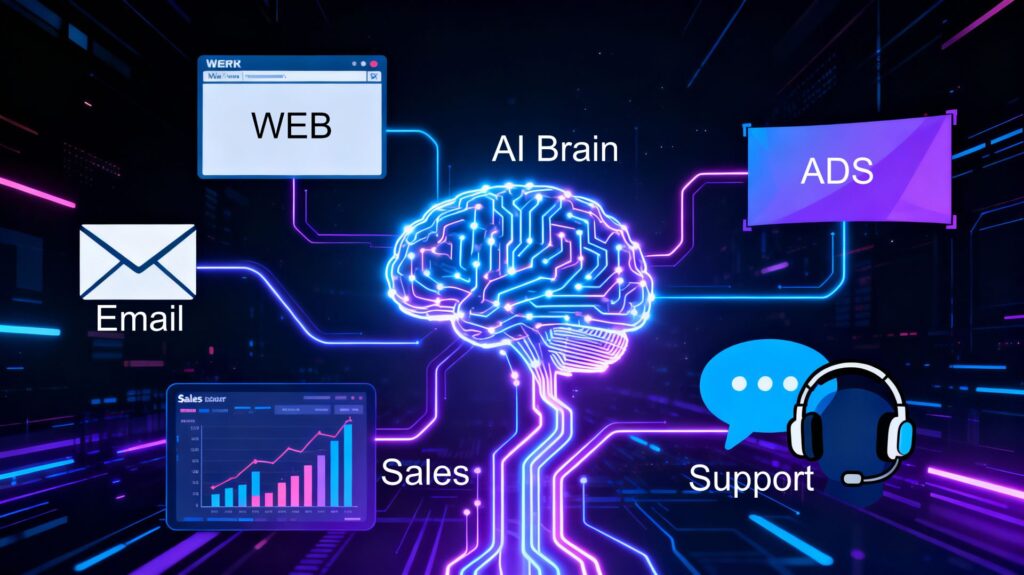
This article explores how AI-driven decisioning is transforming modern marketing in 2026, what it looks like in practice, and how organisations can start building an intelligence-led operating model — the Ennovision way.
The Shift from Automation to Intelligence-Led Marketing
The Limits of Traditional Marketing Automation
- Automated nurture journeys
- Behaviour-based triggers
- Lead scoring models
- Scheduled campaigns
“If X happens, do Y.”
- Customers move backwards and forwards in the journey
- Multiple stakeholders from the same account engage differently
- Behaviour changes between morning and evening
- External events reshape demand overnight
The Emergence of Intelligent Orchestration
- Observe: Ingest signals across channels and systems
- Predict: Estimate intent, value, and risk
- Decide: Select the next best action from many possibilities
- Act: Execute via the right channel at the right time
- Learn: Measure the outcome and update the model
Key Insight: Traditional automation executes predefined logic. AI-driven decisioning *discovers* better logic over time.
The result is a shift from campaign planning to system design. Marketing leaders stop asking, “What journey should we build?” and instead ask, “How should our decision engine choose what happens next?”
This is where Ennovision focuses: helping organisations move from task automation to intelligence-led orchestration.
What Is AI-Driven Decisioning (Really)?
More Than a Feature – An Intelligence Layer
- It reads signals from web, CRM, marketing automation, product usage, support, and even offline interactions
- It evaluates potential actions: send an email, adjust a bid, recommend content, alert sales, pause communication, trigger in-app guidance, etc.
- It weighs trade-offs: short-term conversion vs long-term value, engagement vs fatigue, discount vs margin
“Out of all the things we could do next, this is the one we should do now.”
This is what differentiates AI decisioning from individual “AI-powered” tools.
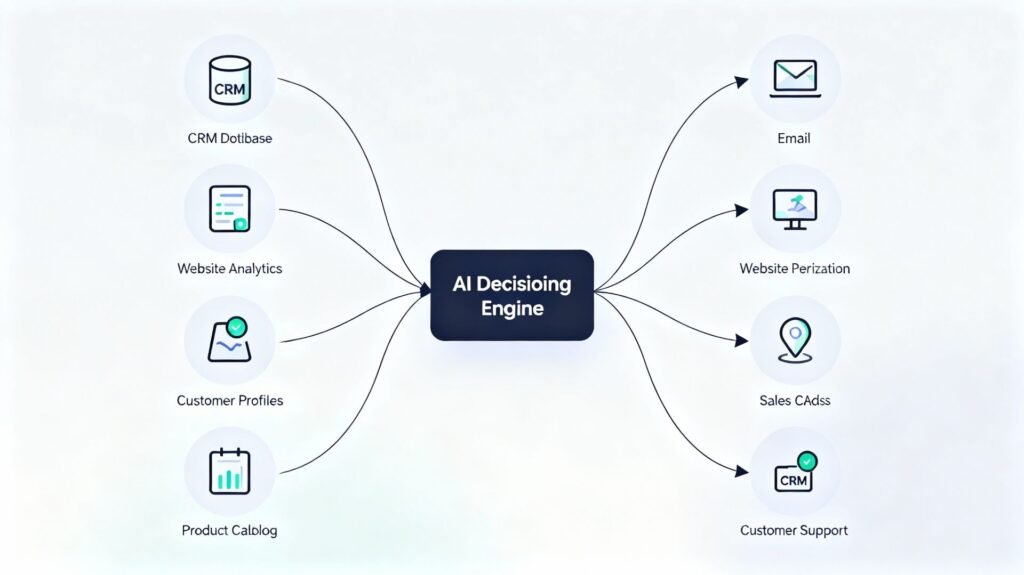
Core Components of a Decisioning Engine
1. Data Ingestion Layer
Brings together signals from disparate platforms into a unified decision context.
2. Predictive & Behavioural Models
Estimate outcomes such as likelihood to convert, churn risk, responsiveness to offers, or channel preference.
3. Business Rules & Guardrails
Ensure the engine operates within acceptable constraints (compliance, brand safety, contact frequency, segment exclusions).
4. Action Catalogue
A library of possible actions the system can choose from (messages, offers, journeys, channels, suppressions).
5. Orchestration Logic
The “brain” that weighs options, runs experiments, and selects the next best action at every step.
6. Feedback Loop
Captures what happened and feeds performance back into the models so the system improves over time.
Design Principle: The most powerful decisioning systems are not those with the most data, but those with the clearest objectives, guardrails, and learning loops.
Why AI Decisioning Has Become Essential in 2026
1. Customer Journeys Have Become Non-Linear and Multi-Modal
Customers freely move across:
- Search → Website → Social → Email → Chat → In-app
- Mobile → Desktop → In-store → Webinars → Communities
They can be at different “stages” of the journey across channels at the same time. A fixed funnel does not reflect this reality; adaptive journeys do.
2. Signal Loss Has Redefined Targeting
- intent
- interest clusters
- content affinity
- channel preferences
3. Local Optimisation Is No Longer Enough
Each platform optimising for its own KPI creates tension:
- Ads optimise for clicks
- Email optimises for opens
- Web optimises for time-on-site
The business, meanwhile, optimises for customer value.
AI decisioning enables global optimisation across channels by aligning decisions to higher-order objectives like lifetime value, incremental revenue, or churn reduction.
4. Teams Are Overloaded With Analysis
More dashboards, more reports, more data — but not necessarily more clarity.
Decisioning reduces cognitive load by moving from:
- “What is the data telling us?”
to - “What should we do next — and what happened last time we did it?”
This shift from insight to action is where competitive advantage emerges.
How AI Decisioning Changes the Role of Marketing Teams
From Campaign Operators to System Orchestrators
In a decisioning-led organisation, marketers spend less time:
- manually adjusting audiences
- rewriting repetitive campaign variants
- shuffling leads between workflows
- exporting/importing lists
And more time:
- defining decision policies and success metrics
- designing creative and offers that the engine can use intelligently
- evaluating how the system is learning
- monitoring for unintended consequences
- collaborating with sales, product, and data teams
“AI doesn’t eliminate the marketer. It eliminates the repetitive decisions that prevent marketers from doing their best work.”
Human-in-the-Loop, Not Human-out-of-the-Loop
AI decisioning still requires human judgment:
- To define “good outcomes”
- To establish ethical and brand guardrails
- To interpret edge cases
- To override decisions when needed
The most effective organisations treat AI as a decision copilot — powerful, fast, and constantly learning, but ultimately accountable to human leadership.

Real-World Scenarios: AI-Driven Decisioning in Action
Scenario 1 – B2B SaaS: Adaptive Journeys for Complex Buying Committees
- One nurture series for “Leads”
- One for “Trial Users”
- One for “Customers”
- Technical users diving into deep documentation early
- Executives skimming ROI content, then going cold
- Prospects jumping between top-of-funnel and bottom-of-funnel content
- The system identifies when technical behaviour spikes and pivots messaging from vision to depth
- It recognises when executive engagement resumes and surfaces tailored value narratives
- It accelerates sales outreach when patterns resemble previous high-conversion journeys
- It pauses nurture during active commercial negotiations to prevent overload
Scenario 2 – Retail & Ecommerce: Inventory-Aware Marketing
A retailer used to run seasonal campaigns regardless of stock realities. At times, successful promotions led to stockouts and poor customer experiences.
With AI decisioning:
- Inventory levels become a signal in the decisioning engine
- When stock drops below a threshold, promotion intensity reduces automatically
- Related products or alternatives are promoted instead
- High-margin items receive more exposure when the system predicts similar conversion likelihood
Customers see relevant products that are actually available. Marketing and merchandising finally act in concert.
Scenario 3 – Travel & Leisure: Emotional and Seasonal Intent
A travel company observes that customers:
- Browse aspirational content when dreaming
- Focus on filters and deals when planning
- Seek reassurance (reviews, flexibility policies) when deciding
The decisioning engine:
- Detects shifts from inspiration to planning (e.g., repeated destination searches, date filtering)
- Adjusts messaging from “Imagine yourself here” to “Here’s how to make it happen”
- Offers flexible options when risk-aversion signals appear
- Triggers upsell opportunities (tours, upgrades) only after core bookings are secure
The journey follows the customer’s emotional rhythm instead of forcing a generic funnel.
Scenario 4 – Subscription Business: Proactive Churn Prevention
A subscription platform used to learn about churn only when customers cancelled.
With AI decisioning:
- Early churn signals (usage drop, reduced login frequency, negative feedback) feed into the engine
- The system tests different interventions: education, outreach, feature prompts, offers
- It learns which combinations work for which segments
- It prioritises human outreach only where it sees high save potential
Churn management becomes proactive, data-driven, and more human where it matters.
What Leaders Need to Build: Architecture, Data, and Governance
1. Start With Decision Architecture, Not Tools
Before selecting platforms, leaders should define:
- Primary outcomes: e.g., LTV, margin, pipeline velocity, churn reduction
- Key decisions: what should the system decide and how often?
- Action catalogue: what actions can it take realistically?
- Guardrails: what must never happen?
- Measurement: how will we know if decisioning is working?
Technology amplifies what already exists.
Clear architecture turns AI into leverage instead of noise.
2. Build a Culture of Continuous Experimentation
AI decisioning thrives in environments where tests are constant, not occasional:
- Always-on experimentation
- Incrementality measurement
- Fatigue and saturation monitoring
- Channel arbitration (which channel should get the next touch?)
This learning culture is as much an organisational requirement as a technical one.
3. Treat Governance as a Strategic Advantage
- Contact frequency caps
- Bias detection and correction processes
- Explainability where required (e.g., in regulated industries)
- Human override mechanisms
- Cross-functional review committees
4. Collaborate Across Functions
Decisioning sits at the intersection of:
- Marketing
- Sales
- Product
- Customer success
- Data and engineering
This is where Ennovision’s approach comes into play: aligning strategy, data, and engineering so that AI decisioning isn’t a marketing experiment, but a company-wide capability.
📎 Learn how Ennovision supports data and AI initiatives through AI-Powered Data Analytics.
Future Trends: What Comes After Decisioning
Multi-Agent AI Ecosystems
- One focused on prediction
- One on content generation
- One on bidding
- One on journey experimentation
AI-Generated Micro Experiences
Instead of a handful of static journeys, brands will deliver:
- dynamically assembled pages
- adaptive product collections
- contextual messaging and layouts
— generated on the fly for each visitor based on real-time intent.
From Predictive to Prescriptive to Generative
Today’s systems predict and, in some cases, prescribe actions.
Next-generation systems will:
- predict what is likely
- prescribe what should be done
- generate the content, experience, or offer to make it happen
All within a governed, human-supervised framework.
Privacy-Preserving Intelligence
Techniques like federated learning and differential privacy will allow decisioning engines to learn from behaviour while protecting individual identities — a critical evolution as regulation tightens.
Key Takeaways and Next Steps
Key Takeaways
- AI-driven decisioning is not a feature; it’s a new operating model for marketing.
- It turns fragmented actions into intelligent, real-time orchestration.
- It thrives even with imperfect data, as long as decision architecture and guardrails are clear.
- It elevates marketing teams from operators to orchestrators.
- It demands cross-functional collaboration and robust governance.
- It is rapidly becoming a baseline capability for organisations that want to compete on customer experience, not just media budget.
Next Steps to Explore
- Map your most critical marketing decisions today — where are humans making repetitive calls that a system could learn?
- Identify where signals are currently fragmented across tools and teams.
- Define a small, high-impact pilot area (e.g., churn prevention, lead progression, or cross-sell).
- Consider how partners like Ennovision can support the architecture, data, and engineering required to make decisioning real — not just conceptual.
📎 Explore how are AI led analytics and Salesforce consulting services support your modern marketing needs:
Cloud Engineering, Application Engineering, and Architecture Consulting.
Conclusion – Competing on Intelligence, Not Just Impressions
As we move through 2026, the organisations gaining real advantage aren’t just the ones spending more on media or buying more tools. They’re the ones making better decisions, faster, and at scale.
AI-driven decisioning is the architecture that makes this possible.
It doesn’t replace the craft of marketing — it amplifies it. It doesn’t remove the need for strategy — it makes strategy executable in real time. It doesn’t sideline human creativity — it creates more room for it by taking on the work machines are better at: high-volume, high-speed, context-aware decision-making.
Final Thought: The future of marketing belongs to organisations that can turn data into decisions, and decisions into experiences, at the speed of their customers’ expectations.
For organisations ready to explore this shift, the question is no longer “Should we use AI?” but “How do we design decisioning systems that reflect our brand, our ethics, and our ambition?”
That’s where the real
Transform Your Digital Vision into Reality
To explore how AI-driven decisioning could reshape your marketing operating model, and how Ennovision can support the architecture, data, and engineering behind it:
