
Key Capabilities
API-led integration, event-driven architecture, data synchronisation, attachment management
Requirement gathering, analysis, design, development and deployment: 26 days.
Executive overview
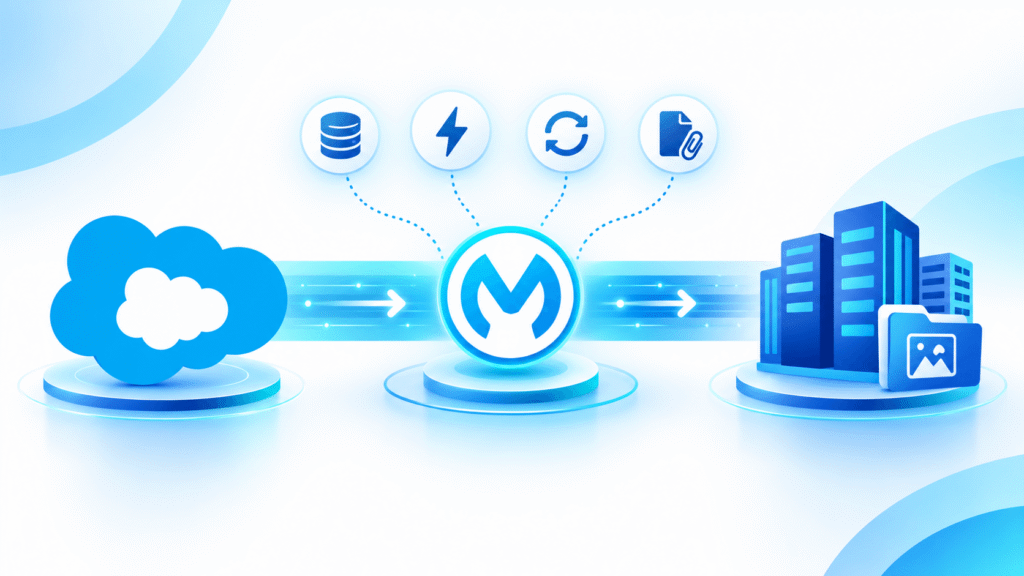
An organisation needed to synchronise selected Salesforce records and associated files with a separate operational platform. The proposed solution used MuleSoft Anypoint Platform to create a one-way integration across four Salesforce objects, map those objects to destination entities and handle attachments through a media API.
Business setting
CRM and operational platforms often serve different purposes. Salesforce may manage relationships and business records, while a specialist operations platform supports downstream processes and documentation. Without a reliable integration, teams may need to transfer information manually, manage duplicate versions or investigate missing attachments. In this engagement, the requirement was not simply to copy data fields. The integration also needed to preserve relationships between records, identify repeated updates and associate relevant media with the corresponding destination record.
A deliberately bounded scope
The estimate specified four Salesforce objects, each to be mapped to a corresponding destination entity during discovery. Synchronisation would flow only from Salesforce to the operational platform. Nothing would flow back. Mapping was expected to be broadly like-for-like, without complex new business rules. Historical backfill was excluded. These constraints made the implementation more estimable, while leaving clear limits on what business users could expect.
Discovery and design
Three person-days were allocated to confirming objects, fields, relationships and attachment types. The team also needed to agree whether the integration should be triggered by Salesforce Change Data Capture, Platform Events or a scheduled process. Lookup rules, reconciliation behaviour, integration design and API specifications formed part of the same discovery activity.
API-led foundation
The foundation workstream comprised four person-days for Anypoint environment setup, secure properties and client credentials, shared error handling, notifications and the system APIs. The Salesforce-facing API was planned to support event listeners where applicable and SOQL access. The destination-facing API was expected to handle authentication, rate limits and retries. This separation is important: it creates explicit interfaces for each platform and prevents individual object flows from embedding all connectivity concerns independently.
Orchestration and mapping
Ten person-days were assigned to the Process API and object flows. The Process API would coordinate DataWeave mappings, object-specific create/update behaviour, parent-child sequencing and lookups. Four object flows were estimated at two days each, supported by orchestration and replay logic. The design also included idempotency through external-ID write-back, an approach intended to prevent repeated events or retries from generating unintended duplicates.
Handling attachments and media
Attachments were a distinct integration requirement, not an afterthought. The planned solution would retrieve Salesforce ContentDocument or Attachment files associated with the selected objects, stream them to the destination media-upload API and link uploaded files to the correct synced records. File size and type validation were included. Three person-days were allocated to this workstream. Attachment handling raises additional questions about API limits, media processing errors and consistency when record synchronisation succeeds but a file transfer fails.
Reliability and recoverability
A dependable integration must anticipate duplicates, transient API failures and partial updates. The proposed design included retry handling, notifications and an error replay flow. It also accounted for destination API rate limits. These capabilities are particularly important when updates arrive in bursts or when downstream availability varies. A replay mechanism can make recovery more controlled, but only if records are identifiable and operations are designed to be idempotent.
Engineering value and conclusion
The planned design demonstrates a practical application of API-led connectivity: system APIs isolate platform details, a process layer that manages mapping and sequencing, and explicit replay and idempotency patterns address operational failure modes. The business objective was to make downstream data and documents available without manual duplication.